

From our work



We've worked with US clients from Chicago since 2010. You get a contact in your time zone and our own full development team behind them, which is how we keep prices well below a typical US agency's.
Work for US clients
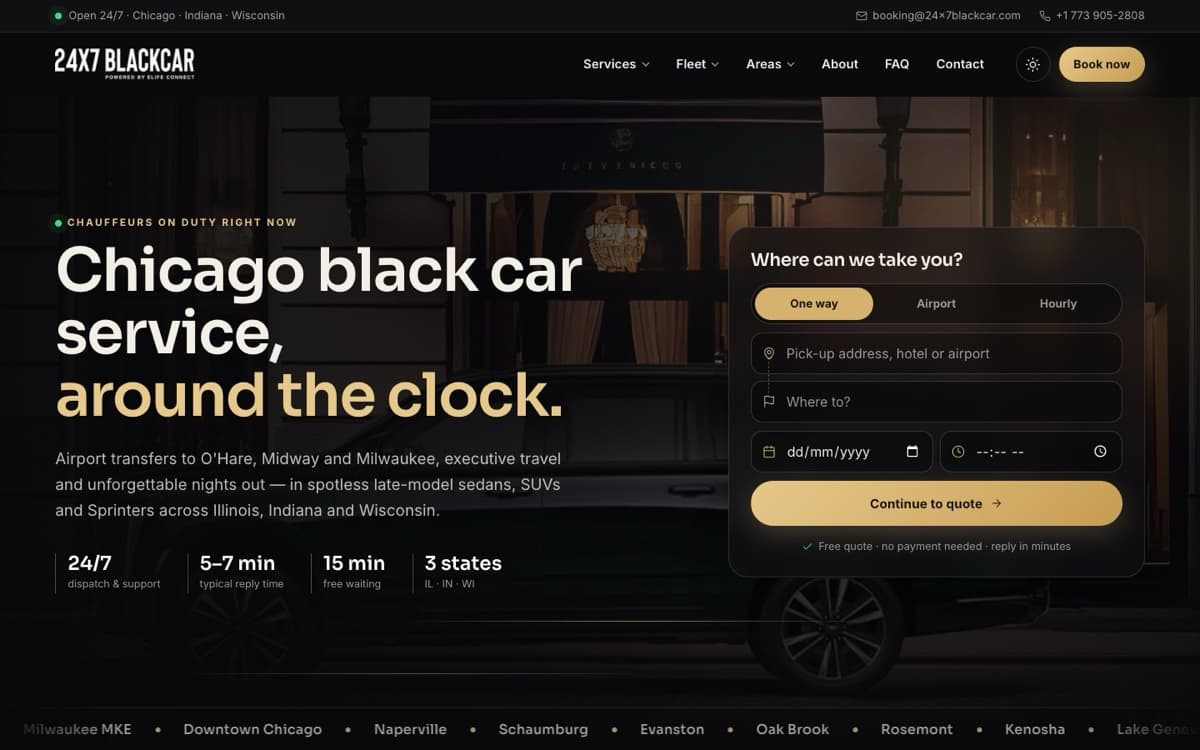
- 24x7 Black Car, a chauffeur service across Chicago, Indiana and Wisconsin: customers enter a pickup and drop-off, see an estimated fare and book in under a minute. See the case study.
- ISPI USA, a Chicago policy institute publishing articles, scholars and events, with donations and membership.
- The Vitamart, the US store for Nutrifactor supplements, and Clippers Corner, a US store for professional barber clippers.
What we build
Booking and ordering systems for service businesses, from car services to clinics.
Customer and member portals with logins, documents, payments and dashboards.
Internal tools that replace spreadsheets and email chains.
Integrations with Stripe, QuickBooks, HubSpot, Salesforce and the tools you already pay for.
Things we take care of for US projects
Accessibility. US businesses face complaints when sites can't be used with a screen reader or keyboard. We build to the WCAG guidelines from the start.
Payments and sales tax through Stripe or Shopify, checked state by state before launch.
Security. Logins, roles, encrypted data and backups as standard, and extra care with hosting and access when health data is involved.
What it costs
A web portal is usually an estimated $800 to $2,000 and six to ten weeks; larger platforms and SaaS products from $1,200 to $5,000. See the service menu or tell us what you need.
Questions we get in the USA
Where is your team?
Projects are managed from Chicago, and built by our own engineering team in Islamabad, Pakistan, with good overlap for calls in US mornings.
Is the work done by freelancers?
No. Developers, designers and testers are our own staff, and you have one project manager throughout.
Do you sign NDAs and contracts?
Yes. NDA before you share details, then a written scope and fixed price for each phase.
Who owns the code?
You do, from the first commit. It lives in your repository and accounts.